The PAAB issues that stall submissions, and how to catch them first



Every round of PAAB comments adds time between an approved idea and a piece in front of healthcare professionals. The comments that cost the most time are rarely surprises. Across our clients’ reviews, the same few sections of the PAAB Code come up again and again: fair balance, absolute claims, how data is charted, and the link to the product monograph.
Here’s what each section asks for, where pieces usually go wrong, and a checklist you can run before you submit.
Fair balance is about the whole page (section 2.4)
Section 2.4 asks that risk information be as prominent as the benefit in the main body copy. Prominence is visual. A reviewer judges it by type size, placement, contrast and space, not just by whether the safety information is present somewhere on the page.
Where pieces go wrong:
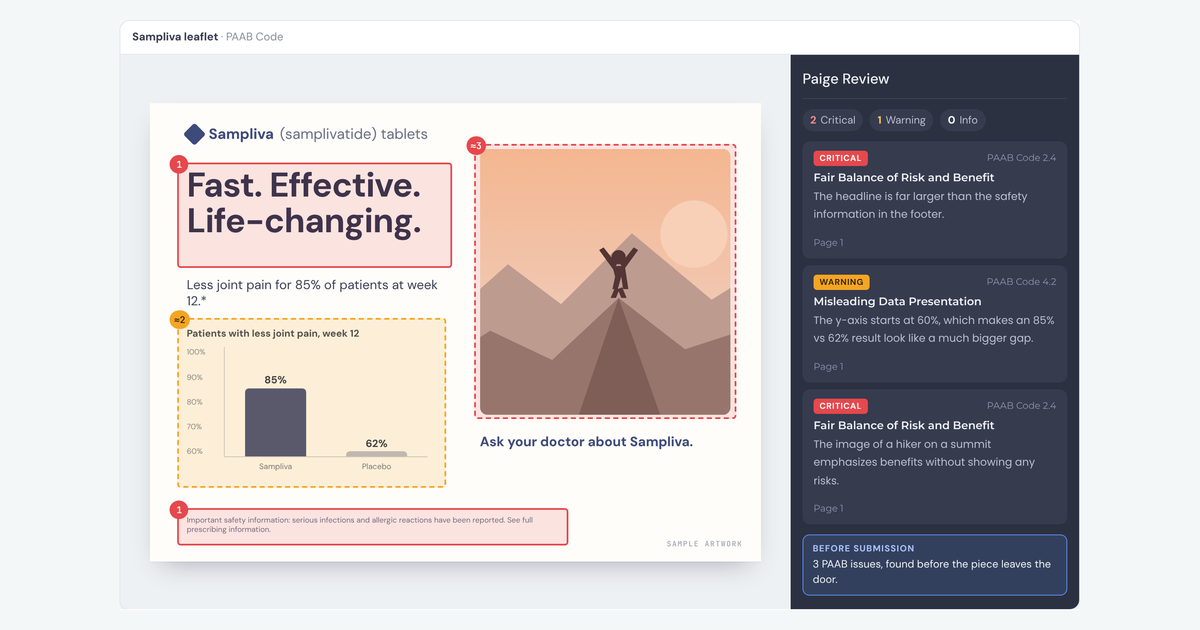
- A large benefit headline over safety information set in small type in the footer.
- Risk information that appears only in the footer, never in the main body.
- Low-contrast safety text on a coloured background.
- Images that show the outcome and nothing of the risk. A photo of a mother holding a baby in an IVF ad, or a patient on a mountain summit in an arthritis ad, makes a benefit claim of its own.
Absolute claims (section 2.6)
Section 2.6 doesn’t allow copy to state or imply in absolute terms that a product is safe, ideal or non-toxic, that its efficacy is guaranteed, or that it is uniformly well tolerated. Section 2.6.1 adds that claims of 100 percent efficacy or safety, direct or indirect, aren’t accepted.
These slip into headlines and taglines most often, where the writing is tightest. Before you submit, search the piece for words like safe, ideal, guaranteed, always, never and 100%, and read each one in context.
Charts that show the true magnitude (sections 4.2 and 4.3)
Section 4.2 expects the overall presentation of data to reflect the true magnitude of the benefit, without magnifying the clinical effect through graphics or type size. Section 4.3 rules out data presentations that are misleading or ambiguous, or that distort the original meaning.
The most common example is a cropped axis. If 85% of patients improved on treatment and 62% on placebo, a bar chart whose y-axis starts at 60% makes a 23-point difference look like a landslide. The numbers printed on the chart are right. The picture they make isn’t.
- Start bar chart axes at zero, or mark a break clearly.
- Keep relative results from being set larger than the absolute ones.
- Watch colour and 3D effects that make one bar look bigger than its value.
- Identify the source of every chart, and label adaptations as adaptations (section 4.1).
The product monograph link (section 7.3)
Section 7.3 sets out how a piece must point readers to the current terms of market authorization, such as the product monograph. For a print piece, that means a URL presented in the form the Code sets out, followed by a statement that the document is also available on request through a stated phone number.
A line like “See full prescribing information” with no URL and no phone number is a common miss.
A checklist to run before you submit
- Is the risk information as prominent as the benefit in the main body, not just the footer?
- Do the images show only outcomes and populations the product is authorized for, and are they balanced by risk?
- Have you searched for absolute words and read each one in context?
- Does every chart show the true magnitude of the result, with its source identified?
- Does the piece carry the product monograph link and the request statement in the required form?
Catch them before PAAB does
Paige Review reads the copy, the charts and the images in each piece against the PAAB Code and flags these issues with the section they relate to, before your submission leaves the door. Your reviewers still make the calls; they just start from a cleaner draft.
See how Paige Review checks promotional content against the PAAB Code →
This article is general information about the PAAB Code, not regulatory advice. Refer to the current PAAB Code for the full requirements.