IVD and RUO statements in device marketing: what the regulation requires, and what your rules add



Device marketing teams work to two kinds of rules at once: what FDA regulation requires, and what their own content approval guidance adds on top. Both matter. Keeping them apart matters too, because a reviewer who can say which rule a comment comes from gets fewer arguments and more consistent pieces.
What 21 CFR 809.10 requires
21 CFR 809.10 covers the labeling of in vitro diagnostic products. It sets the statements that tell a reader what a product is cleared or intended for:
- IVD products carry “For In Vitro Diagnostic Use” on the label (809.10(a)(4)) and in the package insert (809.10(b)(5)(ii)).
- Research use only products carry “For Research Use Only. Not for use in diagnostic procedures.”, prominently placed (809.10(c)(2)(i)).
- Investigational use only products carry “For Investigational Use Only. The performance characteristics of this product have not been established.” (809.10(c)(2)(ii)).
The regulation is written about product labeling: the label and the package insert. It doesn’t say anything about brochures, web pages or slides, and it doesn’t require the statement on every page of a marketing piece.
Why marketing still matters to FDA
FDA’s 2013 guidance on products labeled for research use only or investigational use only explains how the agency decides what a product is really intended for. It looks at the whole picture: labeling, advertising and promotion, presentations, and how and to whom the product is sold.
An RUO product promoted with clinical or diagnostic claims, such as performance claims, help interpreting clinical results, or suggestions that a lab can validate it for diagnostic use, can be treated as a diagnostic that hasn’t been cleared. That’s the reason device companies take their marketing statements seriously, even though the regulation itself is about labels.
The rules companies add
Many device companies write their own rules on top of the regulation into their content approval guidance. Common ones:
- The statement on every page that shows or names the product. Pages travel on their own: a slide pulled into another deck, a page saved as a single PDF, an image cropped for social media. A statement on the cover doesn’t go with them.
- Availability wording, such as “Not available in all regions and countries”, for products whose regulatory status differs from market to market.
- Placement and size: the statement near the product name or image, at a readable size.
These are good rules. They’re just not the regulation, and your guidance should say so. When a reviewer flags a missing statement on page 6, it helps to know whether the comment rests on 809.10 or on your own policy.
Where pages go wrong
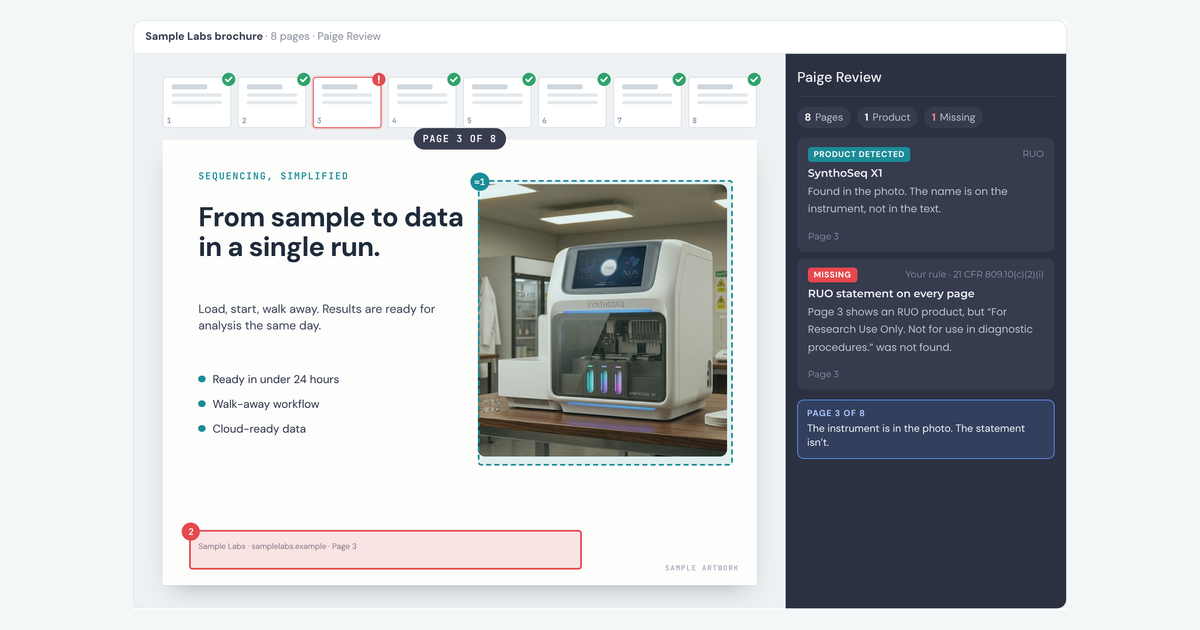
- The product appears only in a photo, with no name anywhere in the text, so nobody thinks to add the statement.
- The statement is on the cover but not on the pages that show the product.
- A page shows both IVD and RUO products but carries only one statement.
- A page is reused in a new piece without its statement.
A checklist for each piece
- List every product on every page, including the ones that only appear in photos.
- Confirm whether each one is IVD, RUO or IUO in the markets the piece is for.
- Check each page for the matching statement, worded exactly.
- Apply your own rules: every page, availability wording, placement and size.
- Read the copy for clinical claims next to RUO products.
Checking every page, every time
Paige Review finds every IVD and RUO product in a device marketing piece, including instruments that only appear in a photo, and checks each page for the statement your rules require. When it can’t match an instrument to a known product, it flags the page for your reviewers instead of guessing.
See how Paige Review checks IVD and RUO statements on every page →
This article is general information, not regulatory advice. Sources: 21 CFR 809.10 and FDA’s guidance, Distribution of In Vitro Diagnostic Products Labeled for Research Use Only or Investigational Use Only (2013).