The FDA promotion issues behind OPDP letters, and how to catch them before MLR



FDA’s rules for prescription drug advertising haven’t changed much in decades. Most of them sit in one regulation, 21 CFR 202.1, with FDA’s guidance documents explaining how the agency reads it on particular topics. What has changed is how strictly they’re applied. The untitled and warning letters FDA’s Office of Prescription Drug Promotion (OPDP) has sent since September 2025 read the same rules more strictly than before, and they reject several habits that older pieces relied on.
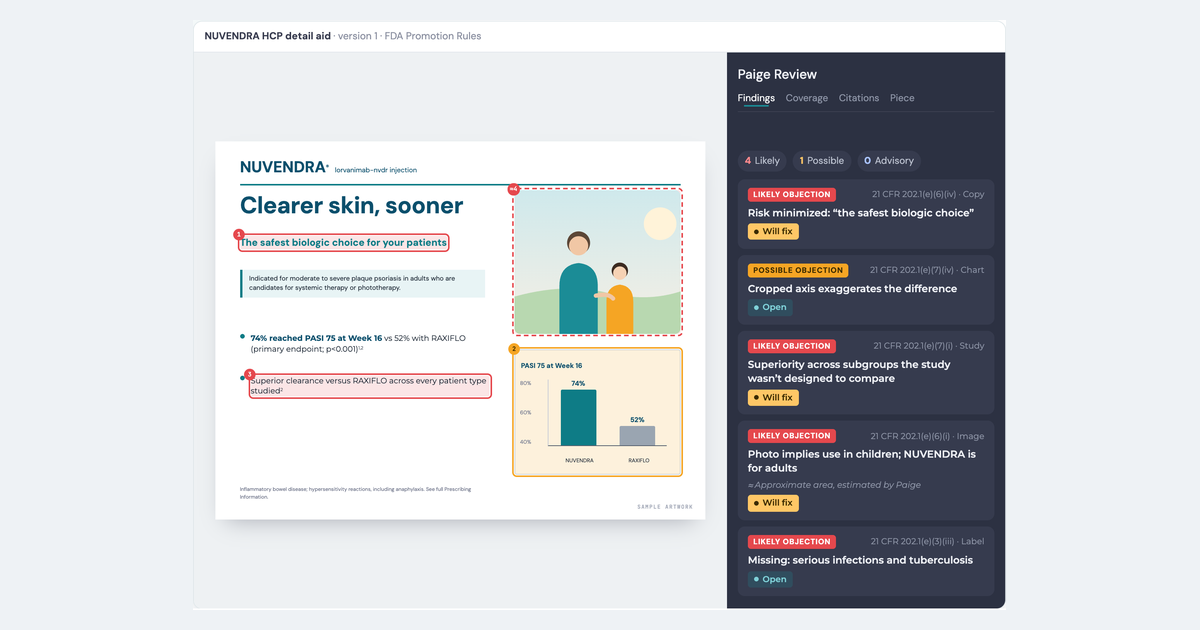
FDA publishes these letters, and they come back to the same few problems: how risk is presented, claims that go further than the label, efficacy claims the evidence can’t carry, and numbers and charts that mislead. Here’s what the regulation asks for in each area, where pieces usually go wrong, and a checklist you can run before a piece reaches MLR review.
Risk information in the piece, as prominent as the benefits
An ad has to present a fair balance between information about effectiveness and information about side effects and contraindications (202.1(e)(5)(ii)). The risk information also has to be about as prominent and readable as the benefit claims, which the regulation judges by typography, layout, contrast, headlines, paragraphing and white space (202.1(e)(7)(viii)). In a piece of more than one page, each page or spread needs the risk information, or a prominent reference to where it is (202.1(e)(7)(xii)).
Where pieces go wrong:
- Benefits in large headlines, risks in small type at the bottom of the last page.
- Serious risks replaced by a link or a line like “See full Prescribing Information”.
- A boxed warning or contraindication left out because the layout ran short of space.
- Risk wording that softens what the label says, such as “generally well tolerated” next to a list of serious adverse reactions. An ad can’t suggest a drug is safer than the evidence shows (202.1(e)(6)(iv)).
Claims that go further than the label
A piece can’t suggest that a drug is better, more effective, or useful in a broader range of conditions or patients than its approved labeling allows (202.1(e)(6)(i)). In practice, the Prescribing Information is the reference point for every claim: the indication, the population, the endpoints and the time points.
- An indication shortened in a headline until it covers patients the label doesn’t, such as dropping “adults” or “after one prior therapy”.
- A limitation of use that appears in the label but not in the piece.
- A secondary endpoint presented as if it were the primary result.
Efficacy claims the evidence can’t carry
A claim needs evidence that can support it. The regulation names the usual weak spots: conclusions from a study that is inadequate in design, scope or conduct (202.1(e)(7)(i)); findings dug out of a study after the fact through retrospective analysis (202.1(e)(7)(iii)); comparisons with another drug that substantial evidence doesn’t support (202.1(e)(6)(ii)); and references cited for a claim they don’t actually support (202.1(e)(6)(x)).
- A subgroup or post hoc result presented with the same weight as the primary endpoint.
- A comparison with a competitor that comes from separate trials, not a head-to-head study.
- A footnote reference that, when you read it, says something narrower than the claim.
- A quality-of-life claim drawn from an exploratory endpoint.
Numbers and charts that mislead
A table or graph can’t distort the relationships or differences it shows (202.1(e)(7)(iv)), and statistical significance can’t stand in for clinical significance (202.1(e)(7)(ii)). For consumer pieces, FDA’s 2023 guidance on presenting quantitative efficacy and risk information says a relative result, such as a 33% reduction, should come with the absolute numbers it’s based on, prominently and in direct conjunction with it.
- A bar chart whose axis starts near the top of the range, so a small difference looks large.
- A relative risk reduction set in large type, with the absolute numbers missing or in a footnote.
- A p-value presented as if it showed the size of the benefit.
A disclaimer doesn’t fix a misleading claim
FDA judges a piece by its overall impression, the words and the pictures together. Headlines, images and graphics can mislead on their own (202.1(e)(6)(xviii)), and a small-print qualifier doesn’t undo the impression a headline or chart has already made. Recent letters say so directly: where a piece adds a line such as “these results are observational in nature and should be interpreted with caution” under a misleading graph, the letter’s answer is that the statement “does not mitigate the misleading impression.”
If a claim needs a disclaimer to be true, the safer fix is usually to change the claim.
A checklist to run before MLR review
- Is the risk information in the piece itself, on every page or spread, and as prominent as the benefits?
- Are the boxed warning, contraindications and serious warnings there, in the label’s terms?
- Is the indication stated in full, with its limitations of use?
- Does every claim match the Prescribing Information: the population, the endpoint and the time point?
- Can the evidence behind each claim carry it? Check subgroup, post hoc and exploratory results, and every comparison.
- Does each cited reference support the claim it’s attached to?
- Do the charts show the true size of the difference, and do relative results come with absolute ones?
- Would the claim still be accurate without its disclaimer?
Checking every piece the same way
Paige Review checks each promotional piece against 21 CFR 202.1, FDA’s guidance on promotion and the product’s Prescribing Information. Each finding is marked on the page and cited to the regulation, before the piece reaches your reviewers. Your team still makes every call; they just start from a cleaner draft.
See how Paige Review checks promotional pieces against FDA’s promotion rules →
This article is general information, not regulatory advice. Sources: 21 CFR 202.1, FDA’s guidance Presenting Quantitative Efficacy and Risk Information in Direct-to-Consumer (DTC) Promotional Labeling and Advertisements (2023), and FDA’s letters to pharmaceutical companies.